Email Us: honyuan@honyuan.com
Call Us: +86-532-86754887
Email Us: honyuan@honyuan.com
Call Us: +86-532-86754887

2026/11/16
The G100 swivel self locking hook is designed for lifting applications where secure load connection and flexible positioning are required. With a swivel design and an automatic locking mechanism, this type of hook is commonly used in Grade 100 chain sling assemblies, industrial lifting equipment, and material handling systems.
Compared with conventional fixed lifting hooks, a swivel hook can rotate to help reduce chain twisting and make load positioning easier. The self-locking mechanism also helps prevent accidental disengagement when the hook is correctly installed and used.
For lifting equipment manufacturers, distributors, and professional rigging suppliers, G100 swivel self-locking hooks are a practical component for building reliable chain lifting assemblies.
A G100 swivel self locking hook is a lifting component designed for use with Grade 100 alloy steel lifting chains and compatible rigging assemblies.
It combines two important functions:
Swivel design: Allows the hook to rotate, helping the lifting chain and connected load align more naturally during handling.
Self-locking mechanism: Uses a locking latch that automatically closes when the hook is engaged, helping prevent unintended release.
The swivel connection is particularly useful when loads need to be positioned from different angles or when chain movement may cause twisting during lifting.
A properly selected G100 swivel hook should match the chain size, working load limit (WLL), connection dimensions, and lifting system requirements.
A G100 alloy steel swivel hook is manufactured from alloy steel selected for lifting applications. The material and heat treatment process are important factors affecting its mechanical performance and durability.
Compared with ordinary carbon steel lifting accessories, properly manufactured Grade 100 components are designed for demanding lifting conditions and higher load requirements.
The actual strength, hardness, and load capacity should always be confirmed through the manufacturer's technical specifications and test documentation.
The swivel structure allows the hook to rotate during lifting operations. This helps reduce chain twisting and makes it easier to position the hook in applications where the load connection direction may change.
A G100 swivel lifting hook can be particularly useful in industrial workshops, construction sites, and material handling operations where lifting points are not always aligned in the same direction.
For models equipped with a bearing, the bearing structure helps provide smoother rotation. Buyers should check the actual product construction because not every swivel hook uses the same internal design.
Load security is one of the main considerations when selecting a lifting hook.
The self-locking mechanism is designed to close automatically after the hook is properly connected. This helps reduce the possibility of accidental opening during normal lifting operations.
Before each use, operators should inspect the locking latch, spring, and other moving components to ensure they function correctly.
A self-locking hook is not a substitute for correct rigging procedures, proper loading, or regular inspection.
The G100 self locking chain hook is commonly selected for Grade 100 chain sling assemblies.
When choosing a hook, buyers should check:
Compatible lifting chain diameter
Working load limit (WLL)
Hook opening dimensions
Connection and attachment dimensions
Applicable lifting standards
Manufacturer's installation requirements
Using compatible components helps ensure that the complete lifting assembly performs as intended.
Some G100 swivel self-locking hooks incorporate a bearing or bearing-supported swivel structure.
The purpose of this design is to allow smoother rotation between connected components. During lifting, chain movement and changes in load orientation can create rotational forces. A suitable swivel mechanism helps accommodate this movement.
For lifting equipment manufacturers and distributors, a G100 swivel self locking hook with bearing may be worth considering when the application requires frequent rotation or more flexible load positioning.
However, the bearing design, maintenance requirements, allowable load conditions, and rotation performance vary between manufacturers.
It is important to review the technical drawing and product specifications rather than assuming that all swivel hooks have identical internal structures.
G100 swivel lifting hooks are used in different industrial lifting and rigging applications. Their swivel connection and self-locking design make them suitable for chain sling assemblies where secure attachment and flexible positioning are required.
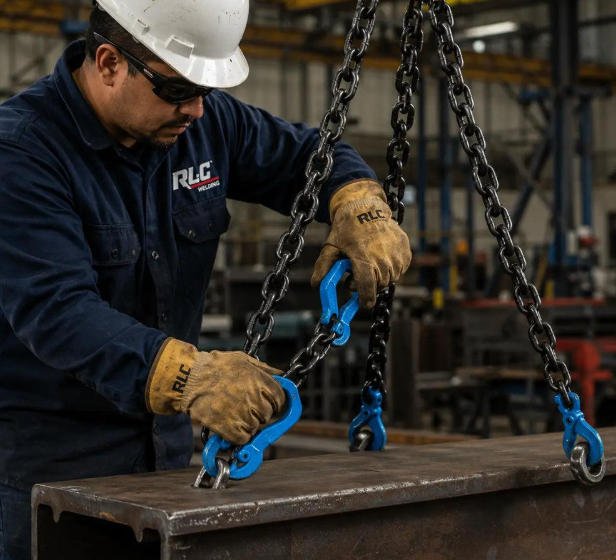
In manufacturing facilities and industrial workshops, lifting chains are frequently used to move machinery, steel components, and heavy materials.
A swivel self-locking hook helps provide a flexible connection between the chain sling and the lifting point.
Construction projects often involve lifting steel structures, concrete components, and other heavy materials.
G100 swivel hooks can be incorporated into compatible chain sling systems used for these operations, provided that the hook capacity and configuration meet the lifting requirements.
Steel plants and metal fabrication facilities handle heavy steel plates, structural sections, and fabricated components.
A suitable swivel lifting hook helps connect lifting chains to the load while allowing more flexible positioning during handling.
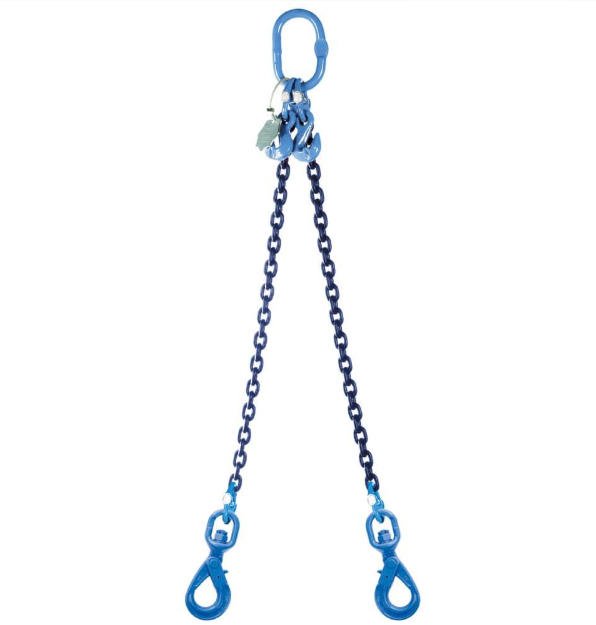
The G100 swivel hook for lifting chain assembly is an important component for manufacturers producing multi-leg and single-leg chain slings.
It can be selected for applications requiring a rotating end connection, depending on the design of the complete sling assembly.
The hook must be matched with the chain, connecting links, and other accessories to ensure the complete assembly has an appropriate rated capacity.
G80 and G100 lifting hooks are both used in industrial chain lifting systems, but they belong to different strength grades.
Grade 100 components are generally designed for higher load capacity relative to comparable Grade 80 components of the same nominal chain size, subject to the applicable product specifications and standards.
| Comparison | G80 Lifting Hook | G100 Lifting Hook |
|---|---|---|
| Strength grade | Grade 80 | Grade 100 |
| Typical material | Alloy steel | Alloy steel |
| Lifting applications | General industrial lifting | Demanding lifting applications |
| Chain compatibility | Compatible G80 chain systems | Compatible G100 chain systems |
| Load capacity | Based on product rating | Based on product rating |
| Selection | Depends on lifting requirements | Depends on lifting requirements |
It is important not to mix G80 and G100 components simply because their dimensions appear similar. The complete lifting system must be designed and rated for the intended application.
Selecting the correct hook is not just about choosing the appropriate strength grade. Buyers should consider the actual working conditions and the requirements of the complete lifting system.
Here are several points worth checking before placing an order.
1. Working Load Limit (WLL)
Determine the maximum load that the hook needs to handle. Always select a product with a suitable rated capacity and follow the manufacturer's lifting instructions.
2. Chain Diameter
Check the chain size and attachment dimensions to ensure the hook is compatible with the existing G100 chain sling assembly.
3. Swivel Structure
Different applications may require different swivel configurations. If smooth rotation is important, ask whether the model uses a bearing-supported swivel structure.
4. Locking Mechanism
Check the latch design, spring operation, and locking performance. The locking mechanism should operate smoothly and close correctly.
5. Surface Treatment and Durability
Surface treatment can help protect the hook against corrosion and environmental exposure. The appropriate finish depends on the intended working environment.
6. Certifications and Test Documentation
For industrial lifting equipment, buyers should request relevant test reports, material information, and compliance documentation. Confirm that the product meets the standards required in the destination market and intended application.
When purchasing lifting accessories for industrial use, product consistency and reliable technical support are important considerations.
Honyuan provides lifting and rigging equipment for industrial customers, distributors, and equipment manufacturers.
When sourcing G100 swivel self-locking hooks, buyers can discuss their requirements with the supplier, including:
Different hook sizes and working load limits
Compatible Grade 100 chain sling components
Product dimensions and technical drawings
Surface treatment requirements
Quality inspection and testing documentation
OEM and bulk order requirements
For distributors and lifting equipment manufacturers, selecting a supplier that understands chain sling configurations can help simplify product sourcing and assembly planning.
Contact Honyuan to discuss the appropriate G100 swivel hook configuration for your lifting equipment requirements.
A G100 swivel self-locking hook is used to connect lifting chains to loads or compatible rigging components. Its swivel structure allows rotation, while the self-locking latch helps prevent unintended disengagement.
A swivel lifting hook allows the connection point to rotate during handling. This helps reduce chain twisting and provides greater flexibility when positioning loads.
Some models feature a bearing-supported swivel structure, while others use different swivel designs. Buyers should check the manufacturer's product drawing and specifications to confirm the internal construction.
G100 and G80 components should not be mixed without explicit approval from the manufacturer and confirmation that the complete assembly is correctly rated. Always follow the applicable compatibility requirements.
Check the required WLL, chain diameter, connection dimensions, swivel design, locking mechanism, and applicable standards. The hook should be compatible with every component in the lifting assembly.
Inspect the hook body for cracks, deformation, and excessive wear. Check the swivel mechanism and locking latch to ensure they operate correctly. Remove damaged or defective hooks from service according to the manufacturer's instructions.
Looking for a reliable G100 swivel self-locking hook supplier for your lifting equipment business?
Whether you are sourcing individual hooks, complete Grade 100 chain sling components, or bulk quantities for distribution, Honyuan can discuss suitable product configurations based on your requirements.
Contact our team for product specifications, technical drawings, pricing, and wholesale supply information.
Send us your required chain size, working load limit, and order quantity to get a suitable product recommendation.


